playbook
How to hire faster without losing quality
What talent leaders would keep, cut and add to make hiring faster without weakening candidate assessment or quality of hire.
By Talent Crunch - Berlin · 2026-09-22
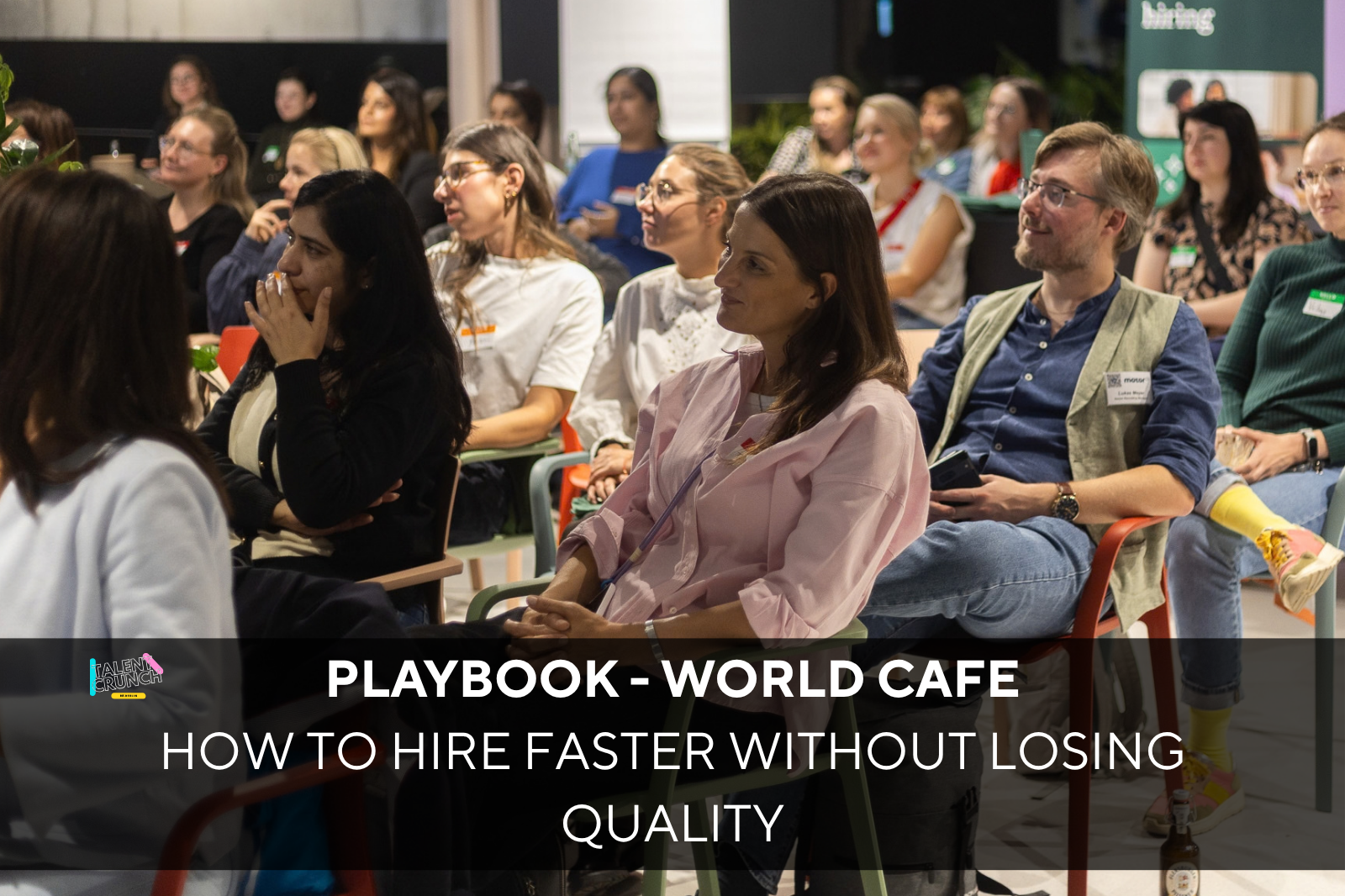
Findings from the Speed vs Quality World Café, Talent Crunch with Greenhouse, Flaconi and Paint Now, September 2026
The board produced nine things to keep, eight to cut and ten to add. Almost everything in the cut column was waiting time or manual work, and nothing in it was an interview step that assesses a candidate.

Keep, cut, add: what the group would change in the process
Keep | Cut | Add |
|---|---|---|
First screening call run by a human | Long gaps between stages and late hiring manager feedback | Panel alignment on expectations before interviews start |
Two interviews, at least one in the office | “Hold on” stages where candidates sit undecided | Calibration with the hiring manager after the first interviews |
Debrief meetings and ad hoc alignment | Recruiting managers reading 200 applications by hand | Clear competencies and a scoring system |
Case studies | Unnecessary interview steps and excess interview rounds | AI CV screening and AI sourcing tools |
Pre-screening questions in the application form | Manual updates, reminders and dashboards | AI notetakers and interview summaries |
TA ownership of the offer and negotiation | Culture add and bar raiser interviews | A recruiting coordinator to schedule interviews |
Pool hiring, several requisitions in one process | Building on the previous interview rather than repeating it |
What should stay human in a hiring process?
Three points carried consensus.
The first screening call stays with a person, because candidates value being seen early and that call sets the tone for everything after it.
Office-based roles include at least one in-person interview, which gives the candidate the same chance to assess us.
The offer and the negotiation stay with TA, because a hiring manager floating a number mid-conversation creates problems that take weeks to unwind, and published salary ranges let candidates rule themselves out before anyone spends time.
The slowest part of most processes came out as the decision that nobody makes. Candidates parked in a “hold on” stage, hiring managers delaying feedback, agencies waiting months for a final rejection.
Do case studies improve quality of hire?
No data was shared at the session that confirms they do. One team dropped case studies during hyper-growth and saw quality decline, and nobody could separate that from the other changes happening at the same time.
What the group agreed on is the format. A presentation with live questions beats a take-home task, because the discussion shows how someone thinks and a written submission no longer proves who wrote it.
Engineering teams use live coding, sales teams use role play, and the exercise matches what the role requires day to day. Long take-home tasks screen out candidates with caring responsibilities or a full-time job, and some withdraw rather than start one.
On candidates using AI in the exercise, the position was that a candidate who can defend the work has demonstrated the skill. As one participant put it, if they work better with AI, that is the job.
Where does AI help in hiring, and where is it a risk?
AI CV screening earned its place for surfacing transferable skills and candidates who undersell themselves in writing. AI notetakers were named as the most underused addition available, both for interview summaries and for flagging where an interviewer may be leading.
AI-led first interviews carry a measurable cost. Greenhouse's 2026 candidate research in the UK found 30% of jobseekers withdrew from a process once they discovered the interview was AI-led, 47% had been interviewed by AI, and 82% of those were not told in advance. Where we use AI in an interview, telling the candidate first is the part that decides whether they stay.
GDPR sets the boundary. Chrome extensions that hand an AI tool access to ATS data were flagged as high risk, data processed in the US may breach some company policies, and an enterprise licence with clear data terms was named as the safer route. Which of our tools currently reads candidate data, and under whose terms?
How many open roles can one recruiter handle before quality drops?
The group put 10 to 15 requisitions as workable for quality hiring.
One member described carrying 25 to 31 at once as “trying not to drown”. External benchmarks sit in the same territory: ATS data puts the average at 14 open requisitions per recruiter, up 56% over three years, while SHRM's median lands at 15 to 20, and quality reliably deteriorates in the 20 to 30 band.
Volume at the top of the funnel is now the bigger problem for many roles.
One team received 150 applications for a part-time L&D assistant role, including senior candidates, and responded by adding pre-screening questions so filtering happens at application rather than three stages later.
Salary auto-rejection split the group: some cut anyone above a threshold, others open a conversation when the gap is under 20k or the candidate is strong, and commission-based roles get treated differently because a high expectation there can signal ambition.

What to change first
Delete the “hold on” stage from your ATS and force a decision date instead.
Set a service level with hiring managers for interview feedback, then report against it.
Replace one manual routine, whether reminders, updates or dashboards, with an automation this month.
Move your screening questions into the application form so filtering happens once.
Tell candidates in writing where AI appears in your process.
Frequently asked questions
How do we hire faster without lowering the bar? Cut waiting time rather than assessment. Delays between stages, late feedback and manual admin shorten a process without touching how we evaluate anyone.
How many interview rounds should a hiring process have? The group settled on two, with at least one in person for office-based roles, plus a human screening call at the start.
Are take-home assignments still worth using? A presentation with live questions gives a better read and excludes fewer people. Long take-home tasks lose candidates with caring responsibilities or full-time jobs.
Should candidates be allowed to use AI in a case study? Ask them to walk through the work. A candidate who can explain and defend their reasoning has shown the skill we are testing.
How many requisitions should a recruiter carry? 10 to 15 supports quality hiring. External benchmarks show an average near 14, with quality deteriorating above 20.
Do we have to tell candidates we use AI in interviews? Disclosure rules vary by market, and the candidate data is unambiguous: 30% of UK jobseekers withdrew from a process on discovering an AI-led interview, and 59% think disclosure should be a legal requirement.
Sources
#hiring process #quality of hire #time to hire #recruiter capacity #ai in hiring #candidate experience #talent acquisition