playbook
AI interviewers in recruitment: where DACH talent leaders would use them now
Senior talent leaders at the Talent Crunch x Ashby dinner on which roles suit AI interviewers, what AI cannot assess yet, the law in Germany and the AI candidate assistant model.
By Talent Crunch · 2026-11-03
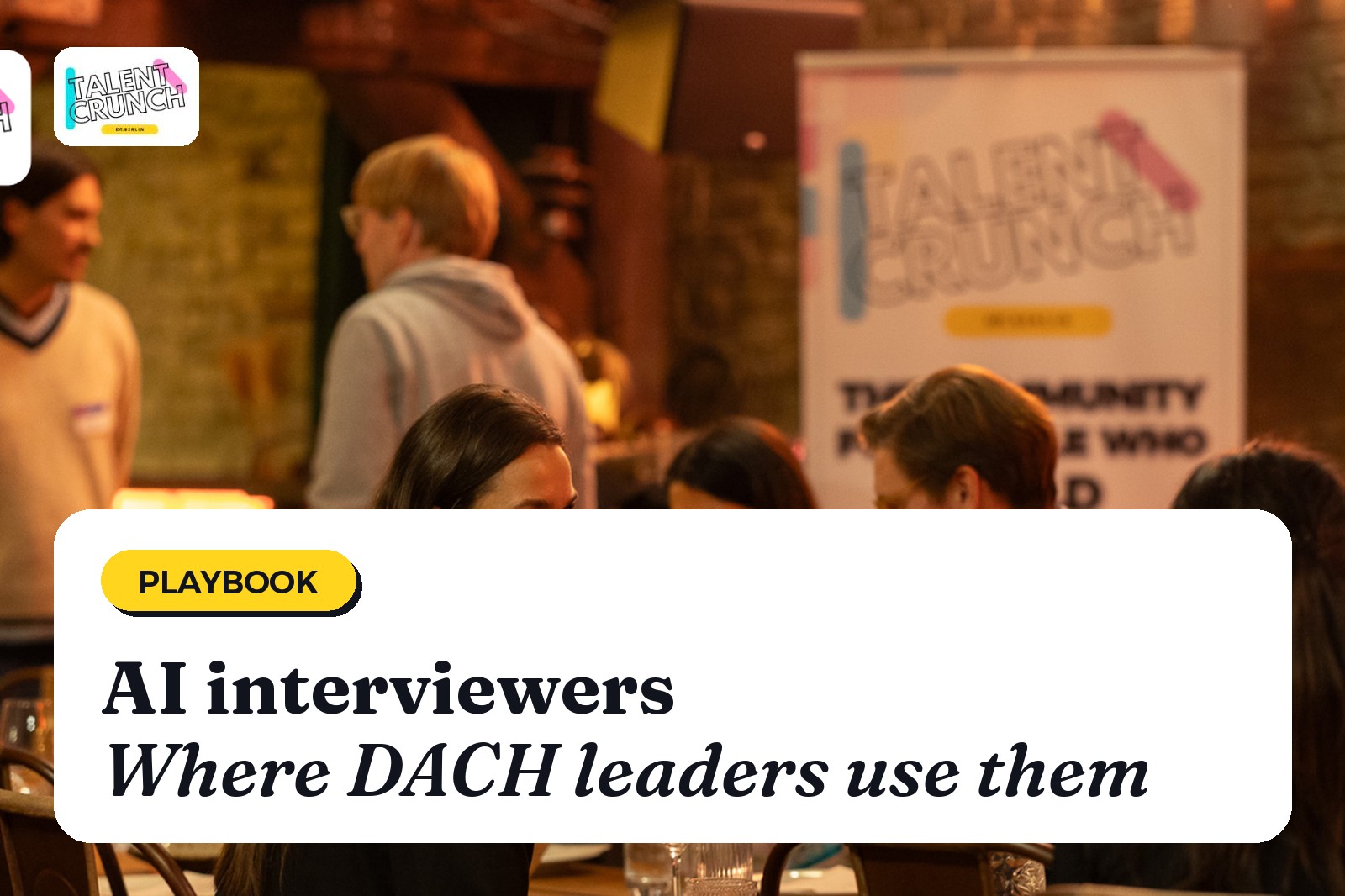
One AI interview model logged a candidate’s ability to tie their shoelaces as an achievement on the scorecard 😬. Senior talent leaders at our October dinner with Ashby on where AI interviewers belong in hiring
A Talent Crunch Playbook - findings from the Talent Crunch x Ashby executive dinner, Berlin, 28 October 2026
One of the 2 roundtables at our 28 October executive dinner, sponsored by Ashby, asked whether an AI interviewer should be the first conversation a candidate has with us. The answer depended on the role, the candidate and the law.

Which roles suit AI interviewers?
Hiring context | How the group rated an AI first interview |
|---|---|
High-volume, entry-level roles | Best fit |
Employers with strong brand recognition | Workable as a first step |
Senior roles, salaries of 100k and above | Not accepted by candidates yet |
Gen Z candidates and people uncomfortable in live interviews | Likely to adapt faster |
US market | More receptive than Europe |
Has AI interviewing worked at scale anywhere?
One participant described AI interviewers in South Korea running fully automated for more than 5 years across 40 channels, with thousands of hires including engineers on salaries above $200,000. We could not verify those figures.
Public reporting confirms Korean companies adopted an AI interview platform in 2018, and nearly 16 percent of 252 firms among Korea’s 500 largest companies use AI in interviews, according to the Ministry of Employment and Labor. Most use the results to check job suitability and keep the final decision with people.
What can an AI interviewer not assess yet?
"One model recorded tying shoelaces as an achievement on a candidate scorecard."
Context. One model recorded tying shoelaces as an achievement on a candidate scorecard.
Behaviour. Models missed arrogance, poor culture fit and pedantic delivery.
Seniority. An experienced recruiter hears the difference between a VP-level answer and one from someone with 3 years of experience. Detailed rubrics with good, medium and bad example answers did not close that gap for the participants who tested them.
Before buying: ask the vendor to score 5 past interviews with known outcomes, including 1 senior hire, and compare the scores with our recruiters’ notes.

Are AI interviews legal in Germany?
GDPR Article 22 prohibits in principle hiring decisions made solely by automated processing, including automatic rejection of applications. Where an exception applies, candidates still have the right to human review and to contest the decision.
The human review has to be real. Under EDPB guidance, a person who approves whatever the tool outputs is likely still part of an automated decision.
Scores can count as decisions. In the SCHUFA case (C-634/21), the CJEU ruled that a score a third party relies on can be automated decision-making.
Untested in hiring. No established case law exists yet on automatic rejection of applications.
EU AI Act. Regulation (EU) 2026/1744 moved the high-risk obligations for employment AI to 2 December 2027. The obligations stay the same.
Works councils. Legal guidance recommends involving them before rollout.
"Who in our process makes the real decision at each AI-scored stage, and could we show it?"
What is an AI candidate assistant?
The use case with the most support: AI working for the candidate, with no decision-making role.
One AI company runs its own voice model as a 24/7 candidate helper. It answers questions on culture, benefits and remote policy, and checks salary range, location flexibility and even the office dog policy before the recruiter call. The recruiter call then covers fit and selling the role.
The AI assistant handles | The recruiter keeps |
|---|---|
Questions on culture, benefits, remote policy | Assessing fit |
Salary range and location checks | Selling the role |
Conversational application forms | The hiring decision |
Conversational application forms also reduce the black-box feeling for candidates and can surface people without a pedigree CV. Two-agent models such as Jack & Jill, with one agent for the candidate and one for the company, bring salary expectations, location and family situation out before anyone books a call.
Will candidates accept AI interviewers over time?
AI interview note-takers felt too early 2 to 3 years ago. Participants now report near-universal acceptance and zero candidate opt-outs, and expect AI interviewers to follow the same curve, more slowly.
2 caveats:
Friction has value. Human interviews build rapport and sell the role. Streaming at home is easier, and people still buy cinema tickets.
AI is talking to AI. Candidates already use AI to answer AI interviewers. Our playbook on assessing AI fluency covers how to get better evidence.
"Streaming at home is easier, and people still buy cinema tickets."
👉🏻 Earlier in the series: AI Is Interviewing Your Candidates. What Leaders Are Doing About It.

Questions to take into your 2027 hiring plan
Which roles carry enough volume for an AI first interview, and which candidates would walk away?
Has a vendor scored our past interviews against our recruiters’ notes?
Who makes the real decision at each AI-scored stage, and is it documented?
Which candidate questions could an AI assistant answer before the recruiter call?
Have we spoken to our works council and data protection officer?
Frequently asked questions
1. Are AI interviews legal in Germany?
AI can support interviews. GDPR Article 22 prohibits in principle hiring decisions made solely by automated processing, so a person has to make a genuine decision.
2. When do EU AI Act rules for AI in hiring apply?
From 2 December 2027, under Regulation (EU) 2026/1744.
3. Which roles suit AI interviewers?
High-volume, entry-level roles. Senior candidates on salaries above 100k expect a human first touchpoint.
4. What is an AI candidate assistant?
An AI tool that answers candidate questions and checks hard facts before the recruiter call. It makes no hiring decisions.
Sources
Regulation (EU) 2026/1744 and AI Act deadlines, ActuIA, October 2026
AI in German employment: AI Act, GDPR and national legislation, Hogan Lovells
AI recruitment in Germany: GDPR, AI Act and works council rules, Compound Law
AI interview platform adoption in Korea, Information Technology & People
Inside Korea’s everyday AI, Korea JoongAng Daily via Daum, October 2023
This roundtable took place at the Talent Crunch executive dinner on 28 October 2026 in Berlin, sponsored by Ashby. The evening was an invite-only dinner for senior talent and people leaders at scaling and enterprise organisations in Germany.
Interested in joining a future dinner? info@talent-crunch.com / Stay in the loop by subscribing here
#ai interviewers #ai in recruitment #gdpr #eu ai act #ai candidate assistant #executive dinner