playbook
AI Is Interviewing Your Candidates. What Leaders Are Doing About It.
One leader automated hiring end-to-end across two portfolio companies. Sourcing, assessment, psychometrics, contracts, pre-onboarding. Every stage had a button to speak with a human. 0.4% of candidates clicked it.
By Talent Crunch - Berlin · 2026-06-05
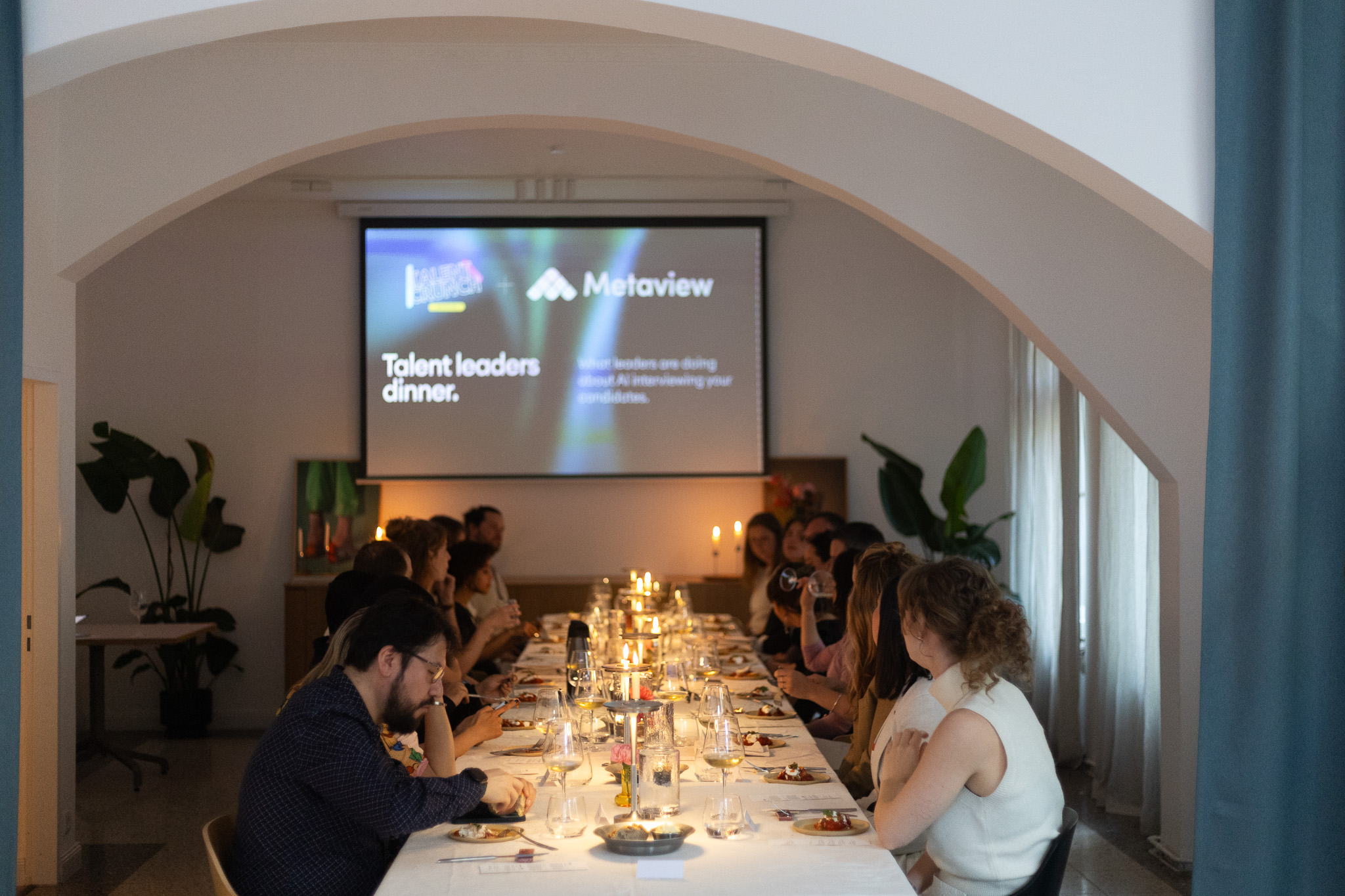
A roundtable recap from the Talent Crunch & Metaview Berlin leadership dinner, May 2025
Senior talent leaders in Berlin sat down for a conversation most of them wouldn't have on LinkedIn. The topic was AI interviewing candidates at the top of the funnel. Where it works, where it doesn't, who's doing it, who's avoiding it, and what's stopping the rest.
Here are some highlights we extract from that evening and we are happy to share them publicly so that others can learn from our insiders’ dinners.

Do you know what your top of funnel costs you?
That was our opening question.
Recruiter hours, time to shortlist, screening calls that lead nowhere. One leader at a large consumer business had done the full analysis - recruiter time, interviewer time, onboarding cost, acquisition cost, through to probation. They shifted their hiring model as a result. Most others hadn't run the numbers.
We cannot make an argument for the efficiency of AI interviewing if we cannot quantify what we compare it against. And most teams haven't.
One leader automated the full hiring process. 4 years ago. In APAC.
Sourcing, assessment, psychometric testing, technical challenges, contract generation, pre-onboarding - all automated across two portfolio companies.
Candidates would show up to a team meeting and decide whether to sign.
Every stage had a button to speak with a human. 0.4% of candidates clicked it.
The system handled 300 to 400 hires per year per organisation, including senior technical roles. Quality of hire went up. The recruiters stayed on, but their roles shifted. When asked what's stopping the same approach in Germany, the answer was: laws, infrastructure, and a board that still wants to interview people themselves.
Candidate experience is the most common objection, but also the weakest.
Several leaders pushed back on the assumption that AI interviewing damages candidate experience. One made the point that we project our own expectations onto a generation that grew up with instant responses and digital-first interactions (super good point!).
They don't want to wait three weeks for feedback. They want speed, clarity, and a decision. If an AI delivers that faster than a human, the experience might be better.
Another reframed it: they'd stopped optimising for candidate experience and started optimising for recruiter experience. The result was lower cost per hire, better candidate satisfaction scores, and faster processes. If your recruiters spend time on the right candidates at the right moment, the experience improves as a consequence.

The real blocker is internal politics and legal ambiguity
Several leaders were candid about the gap between what's technically possible and what their organisations will allow. One leader at an AI company admitted they were behind on internal adoption - not because of legal restrictions or technical limitations, but because nobody had built a strategy around it. The tools and willingness exist. The bandwidth and expertise to implement don't.
The EU AI Act came up repeatedly.
AI in hiring is classified as high-risk, and compliance obligations are approaching. But the conversation revealed something more interesting: most organisations haven't identified who internally is responsible for tracking this. It sits somewhere between legal, TA, and IT, which in practice means it sits nowhere.
One leader shared a cautionary example. Their company was sued by a candidate they never interviewed - a discrimination claim based on language in the job description (that interesting “We require native XYZ Language skills” - we warned so often against). Legal exposure in hiring doesn't require sophisticated AI failures, but maybe one oversight and one motivated claimant.
Fraud is accelerating the case for AI, and also complicating it
Multiple leaders raised the problem of candidates using AI in real-time during interviews - getting coached on behavioural questions, generating scripted answers, presenting polished responses that don't reflect their capability. Traditional behavioural interviewing is becoming unreliable in remote settings.
Some are moving back to in-person interviews for critical stages. Others are shifting toward case studies and live problem-solving. One leader pointed out that AI fraud detection is catching up, drawing a parallel to how exam proctoring technology evolved during COVID - from non-existent to sophisticated within two years.
The consensus: this is happening, the question is pacing
Nobody argued that AI interviewing won't become standard. The disagreement was on timing and approach. One school of thought: move now, experiment, accept the mess. The other: let the early adopters make the mistakes, then adopt their best practices with fewer scars.
A leader from a company with over half a billion in annual profit made a rather sharp observation. Even with full automation of the recruitment function, the cost savings are a rounding error on the business. The board spends more on the meeting where they discuss recruitment efficiency than the efficiency itself would save. The value is freeing up recruiters to have better conversations with the right people at the right time.

This roundtable was part of a full-day programme sponsored by Metaview and hosted by Talent Crunch - Berlin. The evening was an invite-only leadership dinner for senior talent and people leaders at scaling and enterprise organisations in Germany.
Interested in joining a future dinner? info@talent-crunch.com / Stay in the loop by subscribing here
#ai #interviewing #candidates