playbook
We Put 20 Hiring Leaders in a Room and Asked About Pay Transparency, Fairness and AI. Here's what we learnt
20 senior talent leaders in Berlin discussed how their organisations are handling the EU Pay Transparency Directive four weeks after it took effect. This recap covers salary range disclosure approaches, ATS compliance mechanics, the salary expectations field problem, AI
By Talent Crunch - Berlin · 2026-07-06
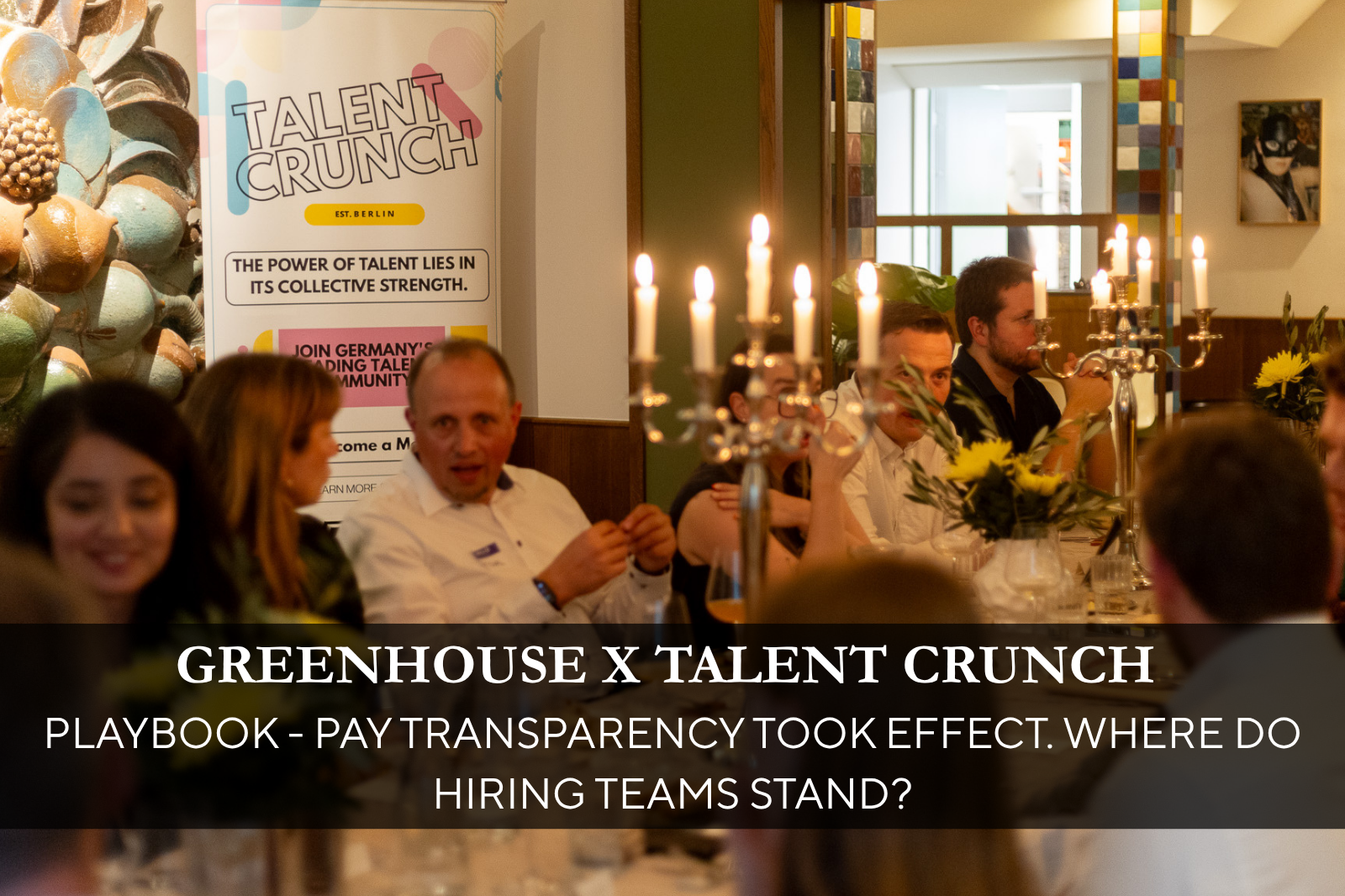
A roundtable recap from the Talent Crunch & Greenhouse Berlin leadership dinner, July 2026
The EU Pay Transparency Directive took effect on 7 June 2026.
Four weeks later, senior talent and people leaders from scaling and enterprise organisations in Berlin sat down for a conversation about what had changed. For most of them, the answer was: less than they expected, and less than they wanted.
This dinner was a collaboration between Talent Crunch and Greenhouse, who sponsored the evening. Two simultaneous roundtable discussions ran in parallel, covering pay transparency implementation, AI in hiring, and what compliance looks like when regulation moves slower than the tools it aims to govern.
Here is what we heard.
Most companies are moving, but few feel ready
The directive is live at EU level. Germany has not transposed it into national law. That gap has created a kind of paralysis; some organisations are pushing ahead, others are using the delay as breathing room, and most fall somewhere in between.
One TA operations leader described insisting to their leadership team that the company should implement salary bands on job ads before the legal deadline, even without German transposition. Leadership agreed in principle but wanted to roll out salary disclosure and internal communication at the same time, which meant delays of several weeks. In the interim, they were disclosing salary ranges to shortlisted candidates individually - by email or by phone - before the first interview.
Someone working across multiple companies described the variance as extreme.
Some clients had spent the previous year building levelling and progression frameworks in anticipation. Others had the topic nowhere on their radar.
Several leaders described a meme-like state of watching and waiting, each company looking at the others, nobody certain where they should be.
One organisation of around up to 200 people had gone further than most.
They had opened pay bands to all employees through their HRIS, audited the whole company against those bands, and found only four people sitting below range - all scheduled for correction in the next compensation cycle. When someone is promoted, they move to the next band. Employees can see where they fall. That level of openness goes beyond what the directive requires, but the team had restructured their compensation model around it.
At the other end of the spectrum, a leader from a company of close to 1,000 people described a situation where M&A activity had created a mess of different compensation philosophies across departments.
Some teams had well-established budgets where posting salary ranges was straightforward. Others - particularly in regulated operations functions - had internal inconsistencies that would surface the moment ranges went public.
Where and when to disclose the salary range is still an open question

The directive requires employers to provide salary information to candidates before the first interview. How companies interpret that requirement varies.
One approach: include the salary range in the automated acknowledgement email a candidate receives after applying.
The logic is that this keeps candidates in the funnel who might self-select out if they saw the range on the job post itself, while still satisfying the pre-interview disclosure requirement. The directive says "before the first interview"; an acknowledgement email is early enough. A job post would be earlier. Neither group had tested this with legal counsel in a way they felt confident about.
Another company was disclosing ranges verbally during the interview stage, paired with inclusive language in job descriptions.
A third was posting ranges on job ads for jurisdictions where it was already mandatory but holding off in Germany until the national transposition clarified what was required.
The largest organisation in the room had taken a different route for global roles. Their TA team had pushed for location-specific salary ranges; their compensation team wanted a single global range. They compromised by categorising roles by job family, with per-team flexibility up to the 90th percentile. For generic postings, they publish the lowest range of the lowest-cost location to the highest range of the highest-cost location. The pre-screen call then carries the full narrative on why ranges look as wide as they do.
Several leaders raised the salary expectations field in their applicant tracking system. Under the directive, employers cannot ask candidates for their salary history.
Whether asking for salary expectations still complies is less clear - one leader's read was that if you are required to disclose the range first, asking what the candidate wants is redundant and possibly non-compliant. Others were still collecting this data through application forms as standard, with the field set as optional. The room did not reach consensus, but the direction of travel was clear: that field will need to change.
Your ATS is now part of your compliance infrastructure

Much of the practical conversation centred on what happens inside the applicant tracking system. For teams using Greenhouse, several features came up.
Pay transparency rules allow teams to set location-specific compliance configurations. If a role is posted for Location A, the Location A rule applies automatically, pulling the salary from a designated field and generating a compliance statement. Teams were discussing how to configure equivalent rules for EU jurisdictions as national laws come into effect.
Mandatory fields in job templates can prevent a role from going live without a salary band attached. One leader described building templates where their TA team cannot open a job without filling in the compensation fields - a guardrail that removes the risk of a role going public without salary information.
The automated confirmation email was raised as a minimum-compliance mechanism. When a candidate is confirmed for a first interview, the email can include the salary range for the role, pulled from the ATS field. Several leaders saw this as the simplest path to compliance that does not require changes to the job post itself.
👉🏻 A concern that came up repeatedly: whether salary data configured in our ATSs transfers correctly to external job boards.
The structured salary field displays properly on LinkedIn and on the company careers page, but when roles are distributed to boards that do not support structured fields, the range may not appear. One leader's workaround was to include the salary range as boilerplate text within the job description itself - a manual step, but one that guarantees the information travels everywhere the job post does
Looking further ahead, several leaders described wanting agentic support within the ATS: a system that pulls salary band data from the HRIS, checks compliance against the relevant jurisdiction, flags risks, and prevents non-compliant roles from going live. The Greenhouse MCP integration was mentioned as a step in this direction, with beta testing reportedly underway. The vision is that opening a job in the ATS should trigger automatic validation against compensation data held elsewhere, without a recruiter needing to log into a separate system and type the number in manually.
Fairness does not end at legal compliance
Beyond the mechanics of disclosure, several leaders shared how their organisations are trying to maintain pay fairness as an ongoing practice.
One company of close to 1,000 people has run the same ritual since they were a hundred-person organisation: every EOY, the CEO announces the annual raise budget as a percentage in a company-wide town hall. The number is tied to revenue and P&L performance. The effect is that employees anchor their expectations before end-of-year compensation conversations, and the company gets consistency across departments. That habit, built years before the directive was on the horizon, means pay has never been a hidden topic in the company.
Another practice raised was quarterly compensation reviews - sitting down with business partners and founders to review each team, identify gaps, spot flight risks, and adjust proactively. You catch problems before they become grievances, and you can explain your decisions when someone asks.
A smaller organisation shared a different model. They built a simple internal tool - minimal code, "vibe coded" was the phrase used - that lets any employee look up salary bands by job family and level. Employees can see where they sit and where they could go. The prerequisite was having salary bands settled first, which is where many larger organisations are still stuck. Companies with recent M&A activity described this as particularly painful; acquired teams in different regions or cities often come with entirely different compensation structures, and aligning them is a multi-year project.

Candidates are gaming interviews with AI, and the assessment model needs to catch up
Several leaders reported seeing candidates use AI agents to submit tailored CVs for multiple roles - the same person applying to a director-level product role and an engineering manager position with entirely different CVs. The result: an automated rejection, because the hiring team cannot determine which role the person has held.
In technical interviews, candidates who perform well in earlier stages are showing visible dependence on AI during live coding rounds.
When asked to work without AI tools, they struggle. One leader described final-stage candidates who could not complete tasks they had apparently handled in earlier assessments.
The room landed on this framing: banning AI from the hiring process is pointless. You would not test someone's ability to write without autocorrect, because they will never need to write without it. The question is what you are testing for. If AI can answer your interview question, the question is the problem
The shift several leaders described was moving away from knowledge-retrieval questions and toward systems design, architectural thinking, conflict resolution, and scenario-based problem solving. "What happens when this breaks"?
One company formalised this. They send AI usage guidelines - reviewed by legal - to every candidate at the application stage, with specific guidance per interview round. Interviewers are trained to detect AI-assisted responses. The approach treats AI as a given and builds the assessment around it, rather than trying to police it.
AI note-taking in interviews has created a consent problem no one has solved
Several leaders use or are considering AI-powered note-taking tools for interviews. The practical benefits are obvious: better documentation, less reliance on interviewer memory, structured data for feedback.
The compliance and candidate experience questions are less settled.
One leader described building a consent workflow within Greenhouse: candidates are told before the interview that a note-taking tool will be active, that it will not influence the hiring decision, and that they can decline. Some candidates say yes. Some say no. Some clearly feel uncomfortable saying no, because they worry it will affect their application.
The parallel to GDPR consent was raised. When you need to agree to data processing to proceed with a recruitment process, the consent is not entirely voluntary. Several leaders expected AI note-taking to follow the same trajectory: candidates will consent because they feel they have to, regardless of preference.
A more practical concern: data retention. If a candidate's profile stays in the ATS for six months after rejection, what happens to the interview recording? Can there be a different retention rule for recordings versus candidate data? One leader had been pressing their Greenhouse CSM on these questions, trying to build a defensible policy before rolling out note-taking more broadly.
The reciprocity question also surfaced. If you record a candidate, what is your policy when the candidate wants to record you?
The interviewer's responses, the company-sensitive information discussed in the interview, the feedback given - all of that could end up in a candidate's recording. Several leaders had not considered this angle.
One acknowledged that tools like Granola - which run silently in the background with no visible indicator - make this question unavoidable.
Regulation is lagging, and nobody is sure who owns the gap
The EU AI Act, which classifies AI in hiring as high-risk, has been pushed back to September 2026. National transposition of the Pay Transparency Directive is incomplete across much of Europe; Poland and Germany have implemented, Ireland has not written it into national legislation, and many member states are behind schedule.
The pace mismatch between technology adoption and regulatory clarity came up repeatedly. One leader observed that a 12-month planning horizon in 2026 feels like what a five-year plan felt like a decade ago. By the time regulation catches up, the landscape has changed.
Inside organisations, the ownership question is unresolved.
Pay transparency compliance sits somewhere between legal, TA, and HR operations. AI governance in hiring sits somewhere between legal, TA, and IT. In practice, both sit nowhere. Several leaders admitted that nobody in their organisation had been formally assigned responsibility for tracking either directive.
What changes if all of this works?

The closing question at both tables was the same: if pay transparency and AI governance are implemented as intended, what does hiring look like 12 months from now?
One leader expected pay transparency to reduce application volume for roles where the salary is below market - a good thing for roles priced well, a problem for sales-heavy teams where compensation structures are complex.
Another saw the AI consent question multiplying: CV matching requires one consent, note-taking requires another, each tool adds another checkbox, and at some point the candidate experience becomes a wall of permissions.
The broader view: TA teams are absorbing more complexity than ever. Each person is doing the work that used to belong to a team of ten or twenty. One organisation is moving toward an internal agency model - a "recruiting as a service" structure with tiered packages, where the business selects and pays for the level of support it needs. The shift puts accountability for hiring outcomes on the business, with TA as the service provider rather than the function chasing stakeholder buy-in.
Whether that model scales is an open question. But the direction is consistent with everything discussed over the evening: TA is a compliance function, a technology function, a data function, and a candidate experience function, all at once. The teams that build the infrastructure now - salary bands, ATS compliance rules, AI governance policies, consent workflows - will be better positioned when the regulation finally catches up. The teams that wait may find the gap harder to close.
This roundtable was part of an invite-only leadership dinner for senior talent and people leaders at scaling and enterprise organisations in Germany. The evening was sponsored by Greenhouse and hosted by Talent Crunch - Berlin.
If you are a senior leader and are interested in joining a future dinner - email us at info@talent-crunch.com
Stay in the loop: https://tinyurl.com/tcupdates26
#pay transparency #ai #fairness #salary #executive dinner