spotlight
Talent Spotlight — Amanda Lamont (No. 3 — 2026)
From clinical neuropsych to 15 years in TA — Amanda Lamont on reverse-interviewing hiring managers, the myth of sharp instincts, and why a hire is just one moment in a longer story.
By Andreea Lungulescu · 2026-05-14
Welcome back to Talent Spotlight — where every month, we shine a light on standout talent professionals and the real stories shaping our industry.
Hey Amanda, tell us a bit about yourself. Who are you, where are you, and what keeps you busy these days?
I'm currently working independently, based between Berlin and Potsdam. I've spent 15 years in talent acquisition, but I came to it through a side door: I was on the road to becoming a clinical neuropsychologist when "life happened" and I ended up in HR — although studying the link between the brain and behaviour still sticks in both professions ;)
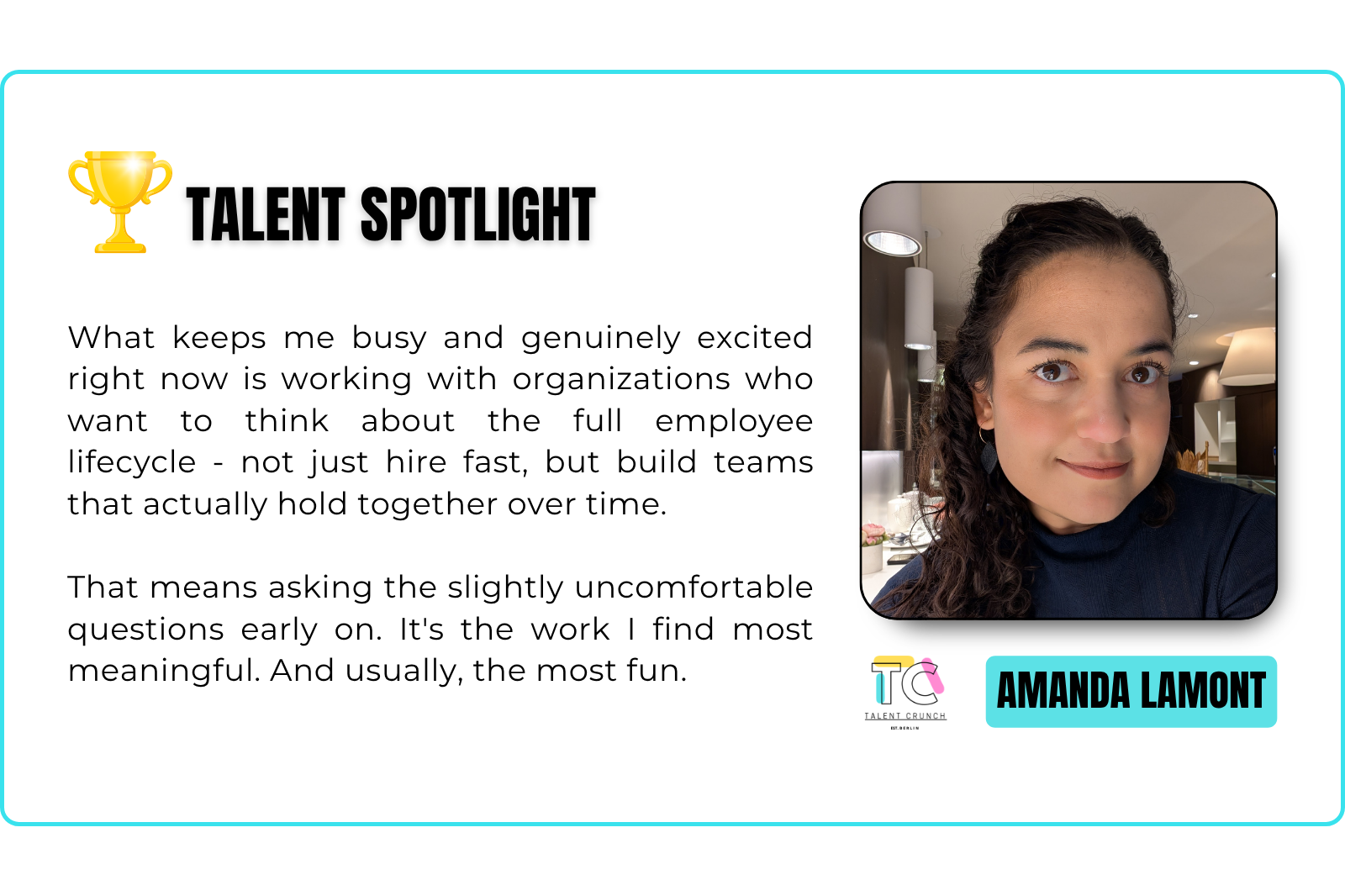
What keeps me busy and genuinely excited right now is working with organizations who want to think about the full employee lifecycle — not just hire fast, but build teams that actually hold together over time. That means asking the slightly uncomfortable questions early on. It's the work I find most meaningful. And usually, the most fun.
Your Story
A big-lesson moment:
Early on in my career during a particularly brutal hiring cycle, I was managing some big gaps — pipeline issues, missed targets, blockers I hadn't flagged. I kept it close to my chest, partly out of habit, partly out of pride. When I finally laid it out to my VP stakeholder, his response was simple:
"If you don't tell me what you need, I can't give it to you."
I'd been treating transparency as a vulnerability when it's actually just good strategy. Since then I put the facts on the table early. Struggling is fine. What matters is how quickly you move toward fixing it.
Something from a completely different field that helped your talent work:
In neuropsych rehabilitation, one of the foundational principles is that you can't treat an injury in isolation. The brain doesn't work in silos — everything is connected, and a disruption in one area creates ripple effects across the whole system.
Same thing in talent: when a team is struggling — poor retention, slow hiring, culture friction — the instinct is to find the broken part and fix it. But usually the "broken part" is a symptom. The real issue lives in the surrounding system: how the team is led, how roles are defined, how growth is supported, what happens after someone is hired. The hire is just one moment in a much longer story — and if the ecosystem around it isn't healthy, even a great hire won't hold.
Talent Talk
The most unconventional thing you've done in recruiting that worked really well:
I reverse-interview my hiring managers during the intake/kick-off briefing. So many hiring managers come into that meeting thinking they know what they need. Most of them don't really — they have a title, a rough sketch of responsibilities, and a gut feeling.
I had a director once who needed to hire his first "Head of" for a new team. Super intelligent, but out of his depth on this one. So I flipped it around — instead of taking a brief, I walked it back with him. What does your team actually do? What's working? What's missing? What does great leadership of this function look like to you? We met again the next day. You could see his eyes light up — overnight he'd connected dots that the first conversation had uncovered. He could now clearly define the role, co-create the hiring plan, and actually pitch the opportunity convincingly :)
A trick or productivity hack that makes life easier:
Granola has been a genuine game-changer for me as a notetaker. I try not to get too comfortable with any one tool for too long. New ones are popping up every week, and what's best value today might be outpaced in a month. So I stay curious — actively testing, comparing, ditching what doesn't deliver.
One thing about TA you've completely changed your mind about:
I used to believe the best recruiter was the one with the sharpest instincts. I now think that's the most dangerous thing we can believe about ourselves. The research is fairly unambiguous: unstructured human judgment in hiring performs barely better than chance. We're not as good at reading people as we think — we're good at reading confidence. That's not the same thing.
The best recruiter isn't the one with the sharpest instincts. It's the one who builds the process that makes instincts less necessary.
Community Connection
Bit of an obvious choice IMO — but it's got to be Andreea Lungulescu. Not a surprise that she's one of the nominees for the Workfully Awards ;) Andreea has always been relentless in her drive, passion, ambition and genuine care for the work she does and the impact it has. Can't think of anyone else right now who deserves this recognition more.
One question you've always wanted to ask:
Tell me what keeps your fire going for TA?
We're operating in an economy that's changing faster than most of our processes can keep up with. The function is under pressure, the tools are shifting, and the expectations on TA have never been higher or more contradictory. That's not a reason to disengage — it's exactly the reason to stay close to the conversation.
#spotlight #systems-thinking #employee-lifecycle #berlin